
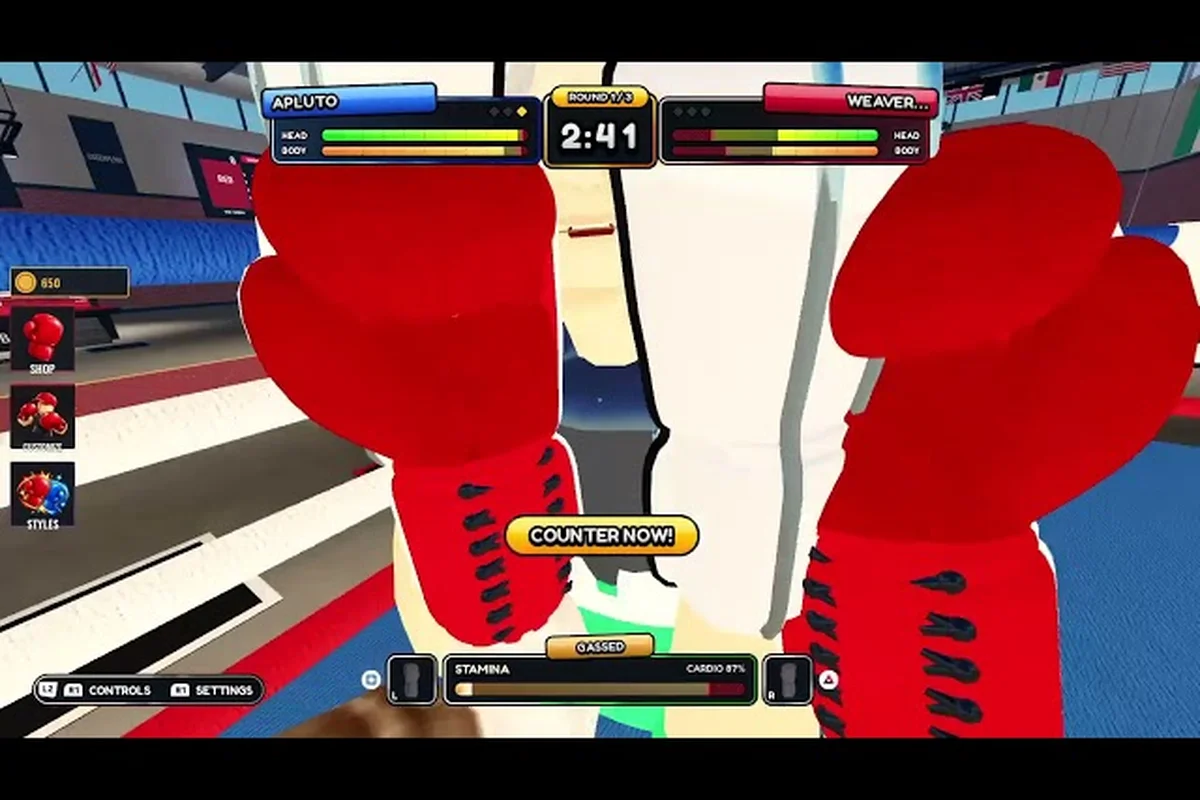
Defense wins fights in First Person Boxing, and clean defensive head movement is what separates a player who gets hit from a player who makes opponents miss on purpose. According to the official store page, the game ships with slips, head and body guards, counters that can produce a knockout, and a stamina pool that slows you down when it empties, so every motion you make under fire has both a cost and a reward. Treat the slip, roll, parry, and block as a single layered toolbox and your counterpunching setups will start landing on rhythm instead of by accident.
How Head Movement Works in First Person Boxing
Head movement in this game is built from three separate inputs layered on top of your guard: a slip input that shifts your head off the centerline, a roll input that bends your upper body around a punch, and a parry input that deflects an incoming shot so you can fire back. The official description names slips, guards split into head guard and body guard, and counters that can produce a knockout as the five core mechanics alongside punches and stamina. None of these have published frame data, so read the section below for the type-level behaviors and rely on practice mode against AI to confirm your own timings.
| Defensive Tool | Primary Use | Stamina Cost | Best Counter Follow-Up |
|---|---|---|---|
| Slip (inside / outside) | Beat a straight punch | Low | Lead hook or straight back |
| Roll (under / side) | Curl around hooks and wide swings | Low–Medium | Cross counter or uppercut |
| Head guard (high) | Absorb head-level shots | Medium drains while held | Push-back straight |
| Body guard (low) | Shield the ribs and solar plexus | Medium drains while held | Body shot then head return |
| Parry | Redirect an incoming punch | Low single-tap | Same-hand counter straight |
The official description does not list exact stamina numbers, so the cost column above is described as relative pressure rather than published values. If you want a deeper look at how range and distance feed into these choices, our First Person Boxing distance management guide maps how being inside, at, or outside the pocket changes which head-movement tool is safest. Holding the head guard on reflex is the most common beginner trap, because it spends stamina every tick without creating an angle, and an empty stamina pool slows you down according to the official mechanic summary.
The Slip: Your First Line of Head Movement
The boxing slip technique in First Person Boxing is the smallest and most efficient defensive move in the game: a short lateral head shift that takes your face off the punch line while keeping your hands and feet loaded to return fire. Because the slip costs very little stamina and recovers faster than a block, it is the default answer to jabs and straight punches coming down the pipe. A common sequence players report in community threads is to hold distance, read the rear-hand telegraph, slip slightly to the side of the lead foot, and then fire a same-side hook into the opening.
When a Slip Beats a Block
A slip wins over a block whenever you have the angle, the stamina, and the confidence to answer. Blocking a jab with the head guard keeps you safe but burns stamina, leaves you flat-footed, and rarely produces a counter window, while a clean slip can move you directly into a counter hook. Think of the slip as a question you ask the opponent: "show me which hand you want to lead with," and your answer is whichever counter your training has drilled the deepest. For a full breakdown of the timing windows that make this trade work, our guide on when to slip in First Person Boxing walks through the three cues most players learn to read inside the first week.
| Situation | Better Choice | Why |
|---|---|---|
| Opponent throws a slow, looping hook | Roll, not slip | A roll clears a wider arc with less risk |
| Opponent jabs from long range | Slip inside | The angle lines up a lead hook |
| Opponent is a heavy counterpuncher | Parry | Parry punishes committed return shots |
| You are low on stamina | Slip only | Blocks drain stamina while held |
| Opponent is using a lot of head movement themselves | Slips + guard switches | Mirror their movement to bait counters |
The Roll: Surviving Hooks and Wide Swings
The boxing roll technique is your second layer of defense, designed for the punches a slip cannot dodge: hooks, wide swings, and any shot that loops around the side of your guard. Rolling bends the upper body under or around the punch, which keeps your chin off the line without committing to a full backstep. The trade-off is that rolls expose the body for a frame or two, so most players use them only when they expect head-level hooks and pair them with a body guard on the way back up.
Roll Directions and Their Returns
There are two main directions to roll: under (which drops the head below the hook arc) and side (which bends the body laterally around the punch). The under roll is a classic counter uppercut setup, because the opponent's hook leaves their chin exposed above you as they swing. The side roll lines up a cross counter, since the hook leaves their body open on the same side you just dodged. If you want a full drill progression for both directions, the how to slip punches guide covers practice-mode setups that build the muscle memory in five-minute blocks.
| Roll Type | Best Opponent Punch | Counter Follow-Up | Risk |
|---|---|---|---|
| Under roll (deep) | Lead hook | Lead uppercut | Body is exposed mid-roll |
| Under roll (shallow) | Rear hook | Cross counter | Slow recovery if whiffed |
| Side roll to lead side | Rear hook | Lead straight | Cross can land before you reset |
| Side roll to rear side | Lead hook | Rear straight | Leaves you flat-footed |
Rolling is the move that gets better the more you layer it with level changes. If you drop your level first, an opponent will often swing a high hook to punish, and the roll puts you in the perfect position to answer. The official store page notes cinematic knockdowns and replays, which means clean counters can lead to highlight-reel finishes when you connect on a rolling opponent.
The Parry: Deflecting Shots to Set Up Counters
The boxing parry technique is the precision tool in your kit. A parry is a small, single-tap deflection that pushes the opponent's punch off-line just enough for you to fire back on the same beat. It is harder to time than a slip because you have to meet the punch at the right depth, but the reward is the cleanest counter in the game: a straight punch landing on a hand that is still extended. Most community reports describe the parry as a high-skill tool that feels invisible once it clicks, because you stop seeing the punch and start seeing the opening it leaves.
Parry Drills That Build Feel
Start by parrying only the jab in practice mode, since the jab is the most predictable single punch in the game and the easiest to read on a schedule. Once you can deflect five jabs in a row without moving your head, add the rear straight as a follow-up so you start building the boxing counterpunching reflex on the same beat. Finally, mix in slips so the opponent does not know which defensive tool you will pick. Drills in this order build the timing window without forcing you to learn four skills at once. For a fuller breakdown of how counterpunching chains into offense, our boxing how to counter guide maps the punch-by-punch answer tree that new players tend to use in ranked matches.
| Parry Target | Common Follow-Up | Difficulty | Why It Works |
|---|---|---|---|
| Lead jab | Rear straight | Easy | Jab is the most telegraphed punch |
| Rear straight | Lead hook | Medium | Opponent's shoulder telegraphs the load |
| Lead hook | Cross counter | Hard | Wide arc makes timing tight |
| Body shot | Upward return | Hard | Less range, easier to smother |
Blocking, Guarding, and the Cost of Playing Safe
The boxing blocking technique is not a single input in this game, it is the combination of the head guard and body guard mechanics the official description names alongside slips and counters. Both guards absorb punches and protect you from clean damage, but they spend stamina continuously while they are held. This matters because the official description also names a stamina pool that slows you down when it empties, which means a tired player holding the head guard is a player who cannot move, slip, roll, or counter for a few seconds. Good head movement is, in a very real sense, stamina management.
When the Block Is the Right Call
Blocks are best used as a reset tool rather than a default defense. If you have just thrown a heavy combination and you need one beat to recover your own stamina, holding the head guard for a half-second while you step back is a smart use of the mechanic. What you want to avoid is the panic habit of holding the head guard every time you see a punch coming, because the stamina drain compounds faster than most new players expect. Think of the block as a parking brake: useful when you are stopped, expensive if you leave it on while you are driving.
| Guard Choice | What It Stops | Stamina Pressure | Best Moment to Use |
|---|---|---|---|
| Head guard only | High punches, jabs | Drains per second | Recovery beat between exchanges |
| Body guard only | Body shots, hooks to the ribs | Drains per second | Opponent is digging to the body |
| Head + body guard toggle | Everything | Drains fast | Last-second survival, not a plan |
| Slip instead of guard | Straight punches | Almost none | Default answer to a jab |
| Roll instead of guard | Hooks | Low | When a hook is fully loaded |
A clean way to think about this is that every guard you hold is a slip you did not throw, and every slip you throw is a counter you can start. The official store page describes the stamina system as a pool that drains with use and slows you down when empty, so budgeting your blocks is the same skill as budgeting your big punches. The cleanest players in the community alternate between one-block resets and two or three slips per exchange, so they never let the pool bottom out.
Putting It Together: Counterpunching Setups Off Head Movement
Counterpunching is what makes head movement feel rewarding instead of passive. Once you can slip and roll on cue, you can start stringing defensive reads into offensive returns, which is exactly what the counterpunching mechanic rewards in the official description. A good setup is simple: one defensive read, one return punch, and a quick exit so you do not get countered yourself. The fastest way to learn is to pick a single setup per practice session and grind it until it feels boring, then add the next.
Three Setups Worth Drilling
The first setup to learn is the slip-straight: when the opponent jabs, slip inside the lead hand and fire a rear straight down the pipe. The second is the roll-cross: when the opponent throws a hook, roll under it and fire a cross counter to the body or head. The third is the parry-hook: when the opponent throws a straight, parry it offline and fire a lead hook into the opening. Each of these uses one defensive input and one offensive return, which makes them easy to learn and hard to master. For a wider look at how these setups connect to the rest of your game plan, the range and distance guide covers how to enter and exit the pocket so your counters actually land clean.
| Setup | Defensive Read | Return Punch | Opponent Tells | Counter-Answer to Expect |
|---|---|---|---|---|
| Slip-straight | Jab coming | Rear straight | Lead shoulder lifts | Lead hook over the top |
| Roll-cross | Hook coming | Cross counter | Rear elbow flares | Pull-back counter |
| Parry-hook | Straight coming | Lead hook | Rear hand chambers | Rear uppercut |
| Roll-uppercut | Wide hook coming | Lead uppercut | Wide arc, low hand | Body shot during recovery |
Reading the Pocket Before You Move
The boxing distance control skill is what lets you choose which setup to use. If you are at long range, you mostly see jabs and straight punches, so slips and parries dominate. If you are at mid range, hooks start showing up, so rolls become more valuable. If you are tied up at clinch range, head movement is less useful and body guards and short counters matter more. The official store page confirms the game supports player versus player and AI in practice, and a smart practice routine is to drill the same setup five times against AI at each range before you take it into a live match.
Training Drills and Practice Routines
Head movement is a habit built in five-minute blocks, not a skill you can learn in one long session. The cleanest practice routine in community reports looks something like this: warm up with two rounds of pure slips against AI jabs, add a roll drill for two rounds, finish with a parry drill for two rounds, and then run live rounds where you only counter. Repeating this three times a week for two weeks is the fastest way to make head movement feel automatic. According to the official store page, the game launched on 28 September 2026 and was last updated on 16 October 2026, so the mechanics are still being tuned and small balance changes are likely between practice sessions.
Building a Weekly Head-Movement Plan
A practical weekly layout looks like the table below. Each block is short on purpose, because short focused drills build clean habits faster than long mixed sessions. If a drill feels boring, that is usually a sign your timing is starting to lock in, so stay with it for at least one more round.
| Day | Drill Focus | Rounds | Goal |
|---|---|---|---|
| Day 1 | Slip-straight vs AI jab | 5 × 90 sec | Five clean slips per round |
| Day 2 | Roll-cross vs AI hook | 5 × 90 sec | Land the cross every time |
| Day 3 | Parry-hook vs AI straight | 5 × 90 sec | One parry per ten seconds |
| Day 4 | Free play, counters only | 5 × 2 min | Only throw after a defensive read |
| Day 5 | Mixed setups in live PvP | 5 × 3 min | Land at least three counters per round |
| Day 6 | Light review, footwork only | 3 × 2 min | Reset before next week |
| Day 7 | Rest | — | Let the muscle memory consolidate |
Players also report that recording their own replays is a strong improvement tool, since the official description lists cinematic knockdowns and replays as built-in features. Watching one of your own rounds at half speed exposes which defensive inputs you are actually using versus which ones you think you are using, and the gap between those two is usually where the next breakthrough lives.
Frequently Asked Questions
What is the single best head-movement tool to learn first in First Person Boxing?
The slip is the best first tool because it costs almost no stamina, recovers fast, and sets up a clean counter straight. Learn it against AI jabs in practice mode until five slips in a row feel boring, then add the slip-straight return punch as your first real boxing counterpunching combo.
How do I stop panic-blocking with the head guard every time I see a punch?
Treat the head guard as a reset tool rather than a default defense. Hold it for one beat when you need stamina, then go back to slips and rolls. The official stamina pool slows you down when it empties, so constant blocking is the fastest way to lose mobility and lose the round.
Does head movement actually save stamina compared to blocking?
Yes. Slips and rolls spend very little stamina per use, while the head guard drains continuously while it is held. Swapping even half of your blocked punches for slips can keep your stamina pool topped up across a long round, which matters because the official description says an empty pool slows you down.
What range should I practice head movement at?
Drill at long range first, because most of the punches you will see there are jabs and straights, which are the easiest to slip and parry. Once your timing is clean, move to mid range where hooks appear and rolls become useful, then practice at close range where body guards and short counters take over.
Can I remap head-movement inputs to fit my playstyle?
Yes. The game supports remapping controls, and our First Person Boxing remap controls guide walks through how to put slips, rolls, and parries on inputs that feel natural whether you play on PC, mobile, or console. Comfortable inputs are how clean head movement starts, so this is a small change with an outsized effect.