
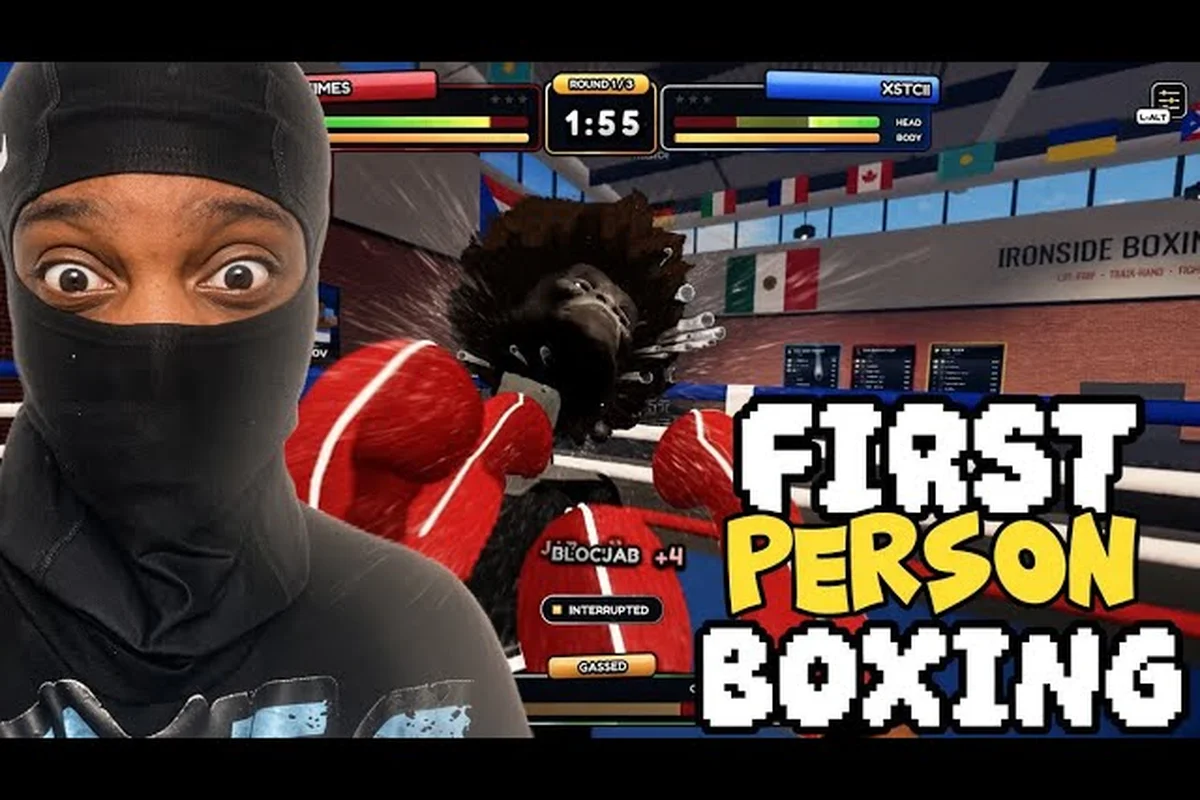
Most players walk into a First Person Boxing sparring session expecting a soft warm-up, but the practice ring against AI is where the game's five core mechanics — punches, slips, head and body guards, counters, and the stamina pool — actually become reflex. According to the official First Person Boxing page on Roblox, the AI opponent is one of only two fight types the developer confirms, and it sits next to ranked mode as the second pillar of competitive preparation. Treating that AI opponent like a real sparring partner rather than a target dummy is the single biggest difference between a player who plateaus and a player who walks into ranked with a working guard, a timed counter, and the stamina to last three rounds.
What Sparring Against AI Actually Is in First Person Boxing
The developer behind First Person Boxing — the group Can You Box? — describes the experience in five mechanics that govern every bout, whether you face another player or the AI. Every punch, slip, counter, and knockout is player-controlled, which means the AI will not rescue you if you forget to slip. Guards are split into two distinct inputs: a head guard and a body guard, and the AI tests both independently. The stamina pool drains as you throw, and when it empties, the official description is clear that you slow down — no exact drain rate or recovery timer is published, so practice is the only way to learn the curve.
Sparring against AI is not a separate unlockable mode the way ranked is. It is a built-in pillar of the experience: the second of the two fight types the official page names alongside player-versus-player. That positioning matters because it frames the AI not as a tutorial but as a long-term training partner. There is no ranked-style "promotion" reward for beating it, and the official page publishes no Elo, MMR, or rating algorithm for the practice ring either. What the AI gives you is volume: a private space to drill the same slip-counter pattern ten times in a row without queuing again.
Why AI Sparring Is Different From PvP
The most common mistake new players make is treating solo versus AI as a chore to "get through" before they touch ranked. In reality, the AI behaves consistently enough to drill specific mechanics. A player-versus-player match has noise — variable skill, bad connections, the social pressure of a 16-player server, and the unpredictability of styles you have not seen before. Sparring strips that noise away. You can isolate one variable at a time: keep your guard high for three full exchanges and count how many times the AI lands clean. The first person boxing solo vs AI loop is closer to a batting cage than a real match.
Players also report that the AI does not throw feints or pressure the way human opponents do. The official page does not name feints as a mechanic, so any feint behaviour you observe against the AI is not a published system. Use that to your advantage. Drill the inputs the developer does name — punch, slip, head guard, body guard, counter, and stamina management — until they are muscle memory. If you want a fuller breakdown of how the AI and PvP modes relate, the modes overview covers the broader mode architecture.
The Stamina Factor Most Players Underestimate
Stamina is the silent mechanic of First Person Boxing sparring. The official description names a stamina pool that slows you when it empties, but it does not publish a numeric curve. That detail gap is exactly why the practice ring exists: you need reps to find the threshold where your hands drop because the pool is empty. A short warm-up session that only throws punches will not teach you the threshold. A targeted drill that throws a head-body-head-body combo, slips once, and then holds guard until the pool refills will.
Setting Up a First Person Boxing Warm Up Routine
A First Person Boxing warm up does not need to be long. Three to five minutes of focused reps in the practice ring will do more for your ranked performance than ten minutes of button mashing. The goal of a warm-up is not to win the sparring session; it is to confirm that each of the five published mechanics responds to your inputs the way you expect before you carry them into a live server. Players who skip this step often discover in round two of a PvP match that their slip input is on the wrong stick, or that they cannot find the body guard under pressure.
Below is a baseline warm-up structure that fits inside one short sparring session. Run it once before your first PvP or ranked match of the day, and again any time you switch platforms (PC to mobile, controller to keyboard). The table breaks each drill into a trigger, an action, and a checkpoint you can self-verify before moving on.
| Drill | Trigger | Action | Checkpoint |
|---|---|---|---|
| Guard Confirmation | Spawn into practice ring | Hold head guard for 5 seconds, switch to body guard for 5 seconds | Both guard inputs register; head shots and body shots are blocked on their respective guards |
| Slip Read | AI throws first punch | Slip left, slip right, return to guard | Hands stay up after each slip; no dropped input |
| Counter Window | After a slipped punch | Land a single counter | Counter lands before AI recovers; stamina still above empty |
| Stamina Probe | Mid-round | Throw a 4-punch combo, then hold guard | Slowdown kicks in only when the pool drains; pool refills when you stop throwing |
| Reset Drill | End of exchange | Reset to mid-ring stance | Stance returns to neutral; no inputs left buffered |
If any checkpoint fails, repeat the drill. The AI does not judge, queue times do not matter, and the sparring ring is the cheapest place in the game to make mistakes.
Warm-Up Tempo: 3, 5, or 7 Minutes?
A common question from new players is how long a warm-up should run. There is no official timer published for sparring, so the right answer depends on the player. A practical heuristic is to run the five drills above back-to-back with no pause, then add a single free round where you box the AI on instinct. If your hands still feel sluggish at the end of the free round, run the table once more. Most players settle into a three-to-five minute rhythm, but the data point that matters is whether you can land a clean counter after a slip without thinking about which input it is. If you cannot, the warm-up was too short.
What to Skip During a Warm-Up
Do not use the warm-up to practice flashy combinations. The official description names five mechanics, and only the five. Anything beyond a single punch, a slip, a head guard, a body guard, a counter, and stamina management is not a published system, so you cannot drill it with intent. Save experimentation for after the warm-up, when the inputs are confirmed and your hands are warm. A warm-up that tries to invent new mechanics is a warm-up that never confirms the ones the developer actually shipped.
First Person Boxing Solo vs AI: How to Drill Without Burning Out
The first person boxing solo vs AI loop is designed for repetition, not for marathon sessions. Players who queue twenty sparring rounds back-to-back usually find that the twentieth round teaches them less than the third, because the AI's behaviour is consistent and the marginal value of each additional round drops fast. A smarter approach is to pick one mechanic per session and run a focused block.
Block Structure for Focused AI Practice
A focused block has three parts: an opener, a rep set, and a cooldown. The opener is a single round where you box the AI on instinct to clear yesterday's muscle memory. The rep set is where the work happens — anywhere from three to eight rounds, all built around the same mechanic. The cooldown is a single free round where you mix everything back together, the way you will have to in a live PvP match.
| Block Phase | Rounds | Focus | Expected Outcome |
|---|---|---|---|
| Opener | 1 | Free boxing, no drill in mind | Hands warm; old inputs flushed out |
| Rep Set | 3–8 | One mechanic (e.g. body guard only) | Mechanics become reflex under repetition |
| Cooldown | 1 | Mix all five mechanics freely | Confirm reps transfer to a free-flow round |
This structure also helps with the stamina question. The official page confirms that stamina slows you when the pool empties, but it does not publish recovery timing. By running a focused block, you notice the stamina curve within a session, not across hours. If your hands start dropping in round six, the block was already too long.
How to Rotate Mechanics Across the Week
A weekly rotation that touches each of the five named mechanics at least once gives a balanced practice base without grinding. A simple four-day loop covers the published mechanics without overlap, and leaves three days open for PvP, ranked, or rest.
| Day | Primary Drill | Secondary Drill | Goal |
|---|---|---|---|
| Monday | Slip-read the AI's jab | Counter window | Hands stay up after every slip |
| Wednesday | Head guard only | Stamina probe | Block head shots for three full rounds |
| Friday | Body guard only | Guard switch timing | Switch between guards without dropping inputs |
| Saturday | Counter-only sparring | Reset drill | Land a counter from a slipped punch in under one second |
Players who prefer a tighter cycle can run the same rotation in two days, but the data point that matters is that each of the five published mechanics gets dedicated reps. AI sparring is not the place to chase variety; it is the place to chase consistency.
First Person Boxing AI Difficulty: What the Settings Actually Do
First Person Boxing AI difficulty is the second-most-asked question about practice after how to unlock it. The official Roblox page does not name difficulty tiers — there is no published Bronze, Silver, or Champion bot — but the AI clearly behaves at different intensity levels based on community testing. Players report that the lowest setting lets you land counters almost at will, the middle setting punishes dropped guards, and the top setting chains punches quickly enough to drain your stamina pool if you do not manage it.
The honest answer is that the developer has not published a difficulty curve. What has been published is the stamina behaviour, so the practical measure of difficulty is how fast the AI can empty your pool. A bot that throws a four-punch combo every exchange is harder than a bot that throws one punch and waits, not because the developer labelled it that way, but because the published stamina mechanic punishes you for absorbing combos.
Picking the Right First Person Boxing AI Difficulty for the Drill
The right difficulty depends on the drill, not the player. A head-guard rep set runs best against a low-intensity AI that throws single punches to the head, so you can confirm the guard without being overrun. A counter drill needs an AI that throws a punch you can read and slip — middle intensity works well. A stamina probe is the only drill that benefits from the highest setting, because you want to feel the slowdown at the published mechanic, not at a tune-down version of it.
| Drill | Recommended Intensity | Reason |
|---|---|---|
| Guard Confirmation | Low | Single-target strikes, easy to read |
| Slip Read | Low to middle | AI must throw, but not chain |
| Counter Window | Middle | Punches must be readable but punishable |
| Stamina Probe | High | Pool must drain at the published mechanic |
| Reset Drill | Any | Free-flow round; the goal is transfer, not difficulty |
When to Step Up the Difficulty
Step up the AI difficulty when the current setting stops punishing your mistakes. If you can hold head guard for three full rounds on low without the AI landing a clean shot, you are no longer learning from that setting. Move up. If you cannot land a counter on middle after three full rounds, drop back to low and rebuild the read. The AI is a measuring tool, and the measurement is broken if the drill is too easy or too hard to learn from.
First Person Boxing PvP vs AI: When to Switch
The first person boxing PvP vs AI decision is not about which one is better. They are different tools. Sparring is the practice ring; PvP is the test. The mistake most players make is staying in the practice ring past the point where it stops teaching them, or jumping into PvP before the five published mechanics are reflex. A balanced weekly loop touches both, and the ratio shifts as the player improves.
A useful frame is the 70/30 rule for newer players and the 50/50 rule for experienced ones. In the first two weeks of play, roughly seventy percent of your ring time should be in the AI sparring ring, with thirty percent in PvP. The point of the AI is to confirm the five named mechanics under no pressure; the point of the PvP is to confirm those mechanics transfer when another human is reading your patterns. By week three or four, the ratio can flip closer to fifty-fifty as PvP starts teaching you things the AI cannot.
| Player Stage | AI Sparring Share | PvP Share | Goal |
|---|---|---|---|
| First two weeks | ~70% | ~30% | Confirm all five named mechanics under no pressure |
| Weeks three to four | ~50% | ~50% | Transfer mechanics to live opponents; learn to read styles |
| Pre-ranked prep | ~40% | ~60% | Sharpen reads and stamina against unpredictable opponents |
| Active ranked | ~20% | ~80% | Maintain mechanics; ranked is the new test ring |
These ratios are not published by the developer, but they match what community testing has shown works for new players. The official page confirms that PvP and AI are the two fight types the game ships with, and ranked mode is the third — confirmed by the RANKED + BUG FIX! event page — but no tier names, MMR, or season structure are published for ranked. Treat the practice ring as the place to install the mechanics, and PvP as the place to test them.
Pre-Ranked Sparring Checklist
Before you queue your first ranked match, run this final sparring block. It is the same five drills from the warm-up, plus a stamina probe at high intensity, and a free round that simulates a ranked opener. If any drill fails, you are not ready for ranked — the AI will surface the gap, and ranked will punish it.
-
Guard Confirmation: hold head guard and body guard for 5 seconds each
-
Slip Read: slip three AI punches without dropping your hands
-
Counter Window: land a counter from a slipped punch in under one second
-
Stamina Probe: high-intensity AI, confirm you can survive a 4-punch combo without emptying the pool
-
Reset Drill: free round, mix all five mechanics, no drill in mind
If all five checkpoints pass, you are mechanically ready for the unpredictability of ranked. The details of how ranked actually rates you are not published, but the mechanics it will test are the same five the developer named in the official description.
Frequently Asked Questions
Is First Person Boxing sparring the same as the AI practice mode?
Yes — sparring against AI and the AI practice option refer to the same built-in fight type. The the official First Person Boxing game page names AI as one of only two fight types alongside PvP, with no separate ranking, MMR, or reward track attached to it.
How long should a First Person Boxing warm up last?
Three to five minutes of focused reps on the five named mechanics is enough for most players. Run the guard, slip, counter, stamina, and reset drills back-to-back, then add one free round — if your hands still feel sluggish, repeat the block.
Does the AI difficulty change the stamina curve?
The developer has not published a numeric stamina curve, but community testing suggests the higher AI intensities chain punches faster and drain the pool sooner. Use high intensity for stamina probes and lower intensity for guard and slip drills.
Can I practice First Person Boxing vs bots with friends?
Practice is the place to confirm mechanics before bringing them into a live server. The mechanics the developer names — punch, slip, head and body guards, counter, and stamina — are the same in every mode, so the practice ring remains the fastest path to clean inputs.
Should I sparring before or instead of ranked?
Sparring is the install step, ranked is the test. Run focused AI blocks until the five published mechanics are reflex, then use ranked to confirm those mechanics hold up against unpredictable opponents. The exact rating algorithm behind ranked is not published.